Excel template or tool: which VSME reporting route suits your business?

Starting with VSME: choose the route that suits your business
First of all: there is no one right way to collect your data for VSME reporting. It depends on how you want to work, where your business is, what you think is important and how you like to work. Below is a thought structure to help you make your own consideration: do you choose an Excel template or online tool?
Stage 1: Waar je nu?
Are you new to sustainability reporting? Then it's good to take a moment to think about what you need to get off to a good start. Some companies want to learn everything themselves and stay in control. Others prefer to opt for a solution where guidance and structure are already built in.
Both choices are legitimate. Ask yourself:
"Do I want to slowly understand and build it myself, or do I want to be guided efficiently?"
Step 2: What do you think is important?
Think about what you prioritise in your organisation. Here are some considerations that can help you:
Do you want to discover, learn and get a grip yourself?
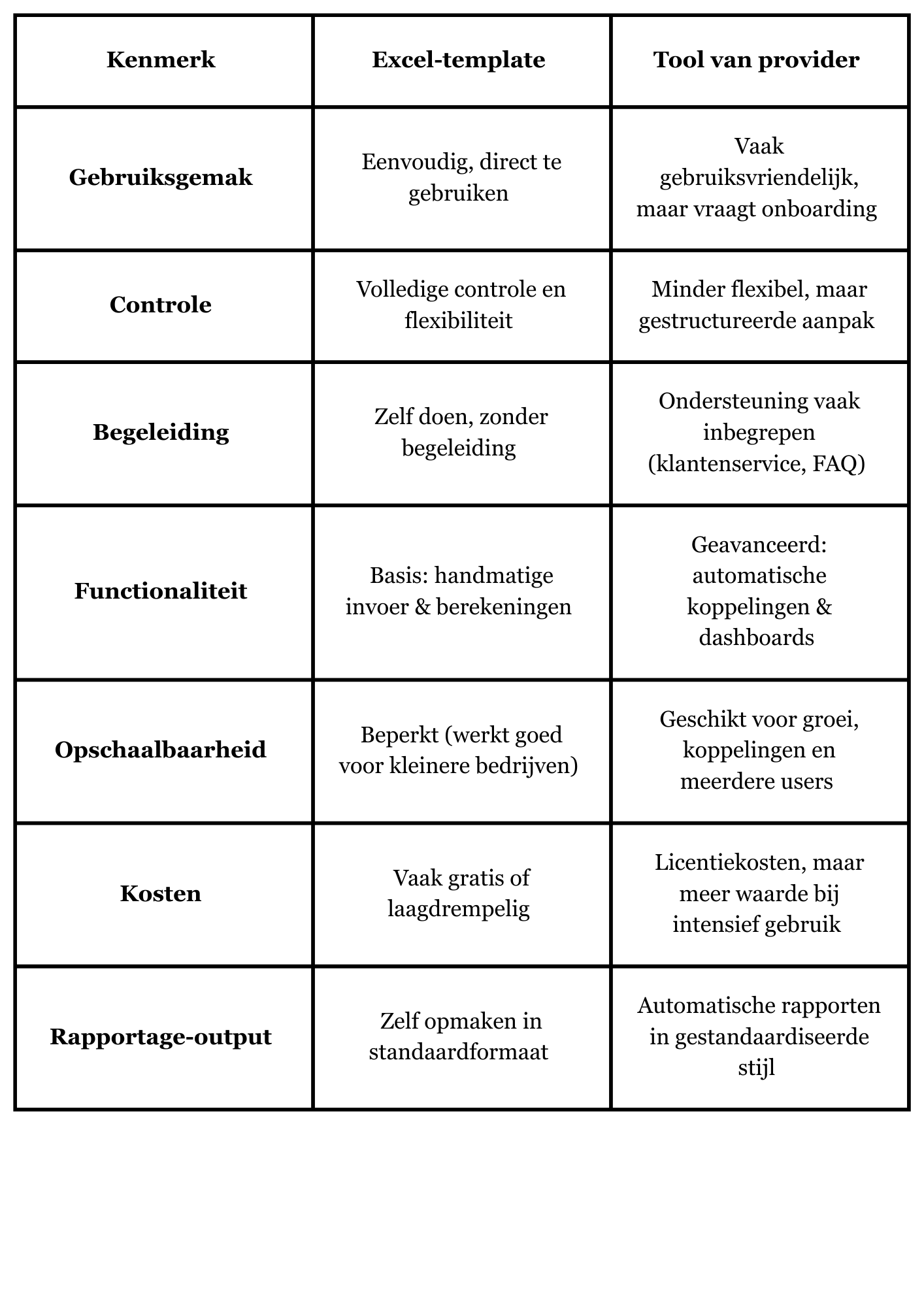
then the Excel template can be a good first step. You build it yourself and set your own pace. You do need time to figure things out yourself.Want to get started quickly and in a structured way?
Then a tool through a provider might be a better fit. Reports are often automatically generated and you meet client or partner expectations faster.
Are you looking for the lowest barrier to entry?
The Excel template requires little investment and can be used immediately. You can always switch to a tool later.
Is it important for your business to be scalable and keep up with growing demands from the supply chain or legislation?
then a tool often offers more longer-term opportunities - think automatic links, benchmarking or professional output.
You already work with (data) systems or have complex chain issues?
Then a tool is a logical choice. You have experience with systems, so feel free to choose an advanced variant. Integration may take some time, but it may be worth it in the long run.
You don't like to be dependent on a third party?
While you are not always dependent on the tool provider when using a tool, you do work within its system. That is a consideration to make.
Would you like external validation and support?
This is a good reason to do choose a tool. The support and guidance you can get with some tools can make the process easier and better.
Would you like to link your data to another system (such as ERP, CO₂-monitoring, customer dashboards)?
then it is useful to choose a tool that has this functionality. Some tools even offer a white label capability.
Tip: whichever way you use, see this reporting as a way to improve your market position. Therefore, make sure your data is well stored anyway, and you can build on it year after year.
Step 3: What weighs most heavily for you?
There is no universal advice. The important thing is to think about what you need in the short and long term. Use the following questions to choose your route:
How much time and knowledge do you have to set up reporting yourself?
How important is it for you to be able to show results quickly?
Are you already used to working with external tools or providers?
Do you want to start small, or build something future-proof right away?
Are you already working through tooling from providers?
By looking honestly at your own situation, you will make a choice that not only fits now, but also matches your ambitions.
Step 4: Start today
For VSME, the main rule is: just start. Once along the way, you will discover that it is not as complicated as it sounds. Find out where you stand with the VSME Readiness Check or download our package of handy documents and tutorials to get started with VSME right away.
And a clear overview of what the difference is between the two methods: